
How to Read Sheet Music: A Beginner's Guide for Piano Players
Learning to read sheet music may seem difficult at first, but it's much like learning a new language. Once you understand a few basic symbols and patterns, you'll be able to play thousands of songs from books, online downloads, and your favorite music collections.
The good news is that you don't need to memorize everything at once. By learning the staff, note names, rhythms, and a few musical symbols, you'll quickly become comfortable reading piano music.
What Is Sheet Music?
Sheet music is a written language that tells musicians which notes to play, how long to hold them, how loud or soft to play, and when to pause. Every symbol has a purpose, making it possible for musicians around the world to play the same piece of music.
For piano players, sheet music allows both hands to work together while creating melody and harmony.
The Musical Staff
The foundation of sheet music is the musical staff. A staff consists of five horizontal lines and four spaces. Notes are placed on these lines and spaces to show their pitch.
Higher notes appear higher on the staff, while lower notes appear lower on the staff.
Treble Clef and Bass Clef
Piano music uses two staves connected by a brace called the grand staff.
- Treble Clef: Usually played with the right hand and contains higher notes.
- Bass Clef: Usually played with the left hand and contains lower notes.
Learning both clefs is one of the biggest milestones for beginning pianists.
Learning the Note Names
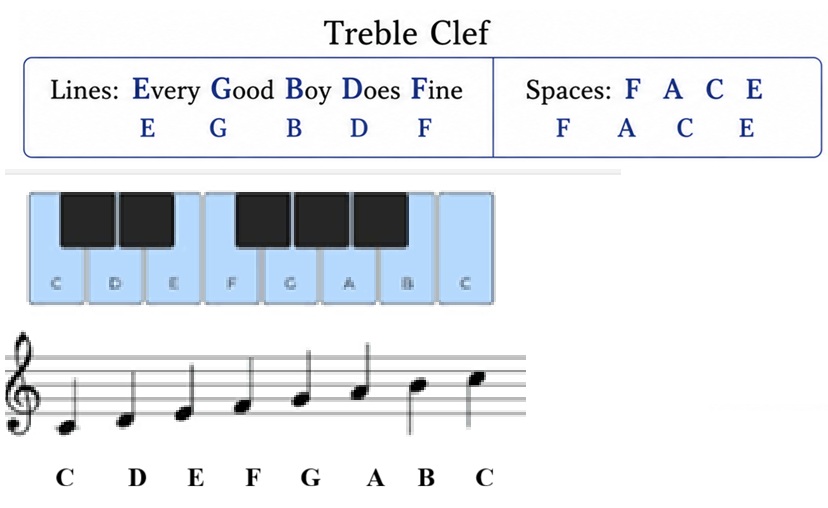
The notes on the piano repeat through the musical alphabet:
A – B – C – D – E – F – G
After G, the pattern starts over again with A.
One easy way to remember the notes on the staff is by using memory phrases.
| Treble Clef Lines | E G B D F | Every Good Boy Does Fine |
|---|---|---|
| Treble Clef Spaces | F A C E | FACE |
These memory aids make learning note names much easier.
Understanding Note Values
Notes tell you both which key to play and how long to hold it.
| Note | Beats |
|---|---|
| Whole Note | 4 Beats |
| Half Note | 2 Beats |
| Quarter Note | 1 Beat |
| Eighth Note | 1/2 Beat |
| Sixteenth Note | 1/4 Beat |
Learning these note values helps you keep a steady rhythm while playing.
Time Signatures
The time signature appears near the beginning of a piece of music. It looks like two numbers stacked on top of each other.
For example:
- 4/4 = Four beats per measure.
- 3/4 = Three beats per measure.
- 6/8 = Six eighth-note beats per measure.
The top number tells you how many beats are in each measure, while the bottom number tells you which note value receives one beat.
Measures and Bar Lines
Vertical lines divide music into sections called measures. Each measure contains the number of beats shown in the time signature.
Breaking music into measures makes it much easier to count and follow the rhythm.
Sharps, Flats, and Naturals
Not every song uses only the white keys on the piano.
- Sharp (#) raises a note one half step.
- Flat (♭) lowers a note one half step.
- Natural (♮) returns a note to its original pitch.
These symbols appear either in the key signature or directly beside individual notes.
Dynamics
Music isn't only about playing the correct notes. It also tells you how loudly or softly to play.
| Symbol | Meaning |
|---|---|
| pp | Very Soft |
| p | Soft |
| mp | Moderately Soft |
| mf | Moderately Loud |
| f | Loud |
| ff | Very Loud |
Following these markings helps bring emotion and expression to your performance.
Practice Tips for Reading Music
Reading music becomes easier with regular practice. Don't try to memorize entire songs immediately. Instead, focus on recognizing notes one measure at a time.
- Practice five to ten minutes every day.
- Say note names aloud while playing.
- Count the rhythm out loud.
- Use a metronome to develop steady timing.
- Learn one hand at a time before combining both hands.
- Review simple songs repeatedly.
Even experienced pianists continue improving their sight-reading throughout their musical journey.
Frequently Asked Questions
How long does it take to learn sheet music?
Most beginners can learn the basics within a few weeks of regular practice. Reading fluently takes longer, but steady daily practice produces excellent results.
Do I need to memorize every note?
No. Over time you'll recognize note patterns instead of identifying each individual note.
Can I learn piano without reading music?
Yes, but reading sheet music opens the door to a much larger library of songs and helps you become a more complete musician.
Is sight-reading important?
Yes. Sight-reading allows you to play new music without spending hours memorizing every note first.
Final Thoughts
Reading sheet music is one of the most valuable skills a pianist can develop. Once you understand the staff, clefs, note names, rhythms, and musical symbols, you'll be able to learn new songs faster and enjoy a much wider variety of music.
Practice a little each day, be patient with yourself, and celebrate small improvements. Every page of sheet music you read builds confidence and brings you one step closer to becoming a skilled piano player.
Piano Related Articles
- Common Chord Progressions Every Piano Player Should Know
- How to Choose the Perfect Piano: Beginner Piano Buying Guide
- How to Get a MIDI File for Almost Any Song Using A
- How to Read Sheet Music: A Beginner's Guide for Piano Players
- MIDI vs Sheet Music: What's the Difference
- The C Major Scale and Common Chord Progressions Explained